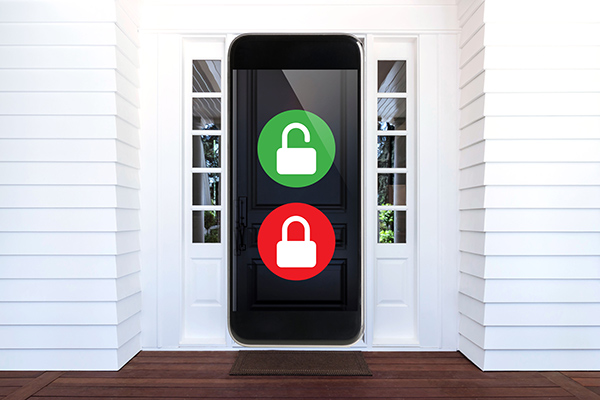
Forget to lock your front door? Now you can do it with just a few taps on your phone, thanks to the smart lock.
What is a smart lock, exactly? It’s a way to lock and unlock your door without using a regular metal key. There are many variations, but smart locks allow you to open and close a dead bolt electronically using a numeric code or touchscreen—often in conjunction with an app on your smartphone.
Smart locks are becoming increasingly popular—the global market for them is expected to hit $24 billion by 2024, according to one report, and the fastest growth is happening in the residential space. That means an ever-growing number of home smart locks with various functions and options. But is a smart lock a good choice or is it just another fancy gadget you can do without?
That depends, says Joel Dhein, president of the National Crime Prevention Association. In terms of helping to keep intruders out, having a dead bolt in good condition—and using it—is a more important consideration than how you operate it. The decision to swap locks really hinges on your wants and needs. (One note: if you’re renting, check with your landlord before you change the locks.)
Here’s what Dhein sees as the pros and the cons of smart locks.
Ready to Protect Your Home?
See how homeowners insurance could help protect what matters most.
Get a Quote Learn MorePros Of Having A Smart Lock
Ease Of Entry
With a smart lock, you won’t have to fumble for your keys or jiggle the key in the lock to get it to open.
Convenience
If you’re expecting guests or a house sitter to come by while you’re away from home, you can input special codes for each person or group, along with an expiration time for each code. Also, if you’re worried that someone with a key (like a former property owner) may try to enter your home, you can just change the code, saving you the hassle and cost of changing the lock.
Peace Of Mind
Another benefit of having codes is that you can track who’s come in and out, so you’ll know if and when, say, your child has arrived home. Also, with many smart locks, you can see whether the door is locked or unlocked from your phone, so you can double-check its status from anywhere in the world.
Protection From Lock Picking
Traditional locks may be subject to lock picking or lock bumping—methods that thieves can employ to try to open locks without the original key. Some smart locks don’t have a key slot, thereby removing the risk of this kind of break-in. That doesn’t, however, necessarily make smart locks more secure. (More about this below.)
Connectivity With The Rest of Your Home
If you have other smart home devices, you may be able to interconnect them so that, say, your smart lights turn on when you unlock the door.
Cons Of Having A Smart Lock
Reliance On Phones And Networks
Smart locks communicate with your phone, usually via Bluetooth or Wi-Fi. If your phone is stolen, you lose it or it dies, you could get locked out if you don’t have a backup plan (like logging in to your account on another device). Also, if a power outage shuts off the Wi-Fi, you wouldn’t be able to use features (like remote unlocking) that rely on a Wi-Fi connection.
Potential For Hacking
While some smart locks remove the threat of lock picking, they may be subject to attempts by hackers to override the entry code that can unlock the door. On the plus side, the system may be able to notify you (and the police) if an unauthorized user accesses the system.
Batteries
Unlike old-school locks, smart locks are battery-operated systems and batteries can die. You must pay attention and change the battery before it runs out of juice.
Cost
Smart locks can cost significantly more than standard lock-and-key systems and you may need a pro to install the lock and sync it to your Bluetooth and Wi-Fi. Smart locks can also be pricey to fix if they malfunction.
Are the pros enough to outweigh the cons? That’s up to you. However you decide to lock and unlock your door, remember that there’s no substitute for a dead bolt.
Here’s another smart idea: lock in savings! Get a quote on homeowners insurance through the GEICO Insurance Agency and see if you could save!
Ready to Protect Your Home?
See how homeowners insurance could help protect what matters most.
Get a Quote Learn More